
Selecting the right AI automation services is crucial, and utilizing effective AI automation tools is the ultimate shortcut to scaling business operations. In 2026, companies are moving beyond basic scripting to hyper-intelligent systems that adapt in real time.
By adopting these advanced tools, your organization can eliminate redundant tasks and empower creative thinking. Let us explore how modern software elevates performance across departments.

Why AI Automation Tools Are Vital for 2026 Growth
Modern enterprises must leverage AI automation tools to stay competitive in a fast-paced global economy. These applications streamline complicated workflows instantly.
Implementing modern systems enables business process automation, allowing teams to focus on strategic development rather than manual data entry tasks.
Core Capabilities of Modern Platforms
High-performing solutions integrate cognitive capabilities to read, analyze, and execute actions based on unstructured data inputs.
The adoption of generative AI for enterprise applications ensures that content creation and decision-making are both accurate and contextual.
Top 10 AI Automation Tools to Streamline Operations
Leading AI Automation Tools for Enterprise Scale
1. Zapier Central: Excellent for creating custom AI bots that handle dynamic API calls without requiring developer resources.
2. Make.com: Provides visual workflow mapping enriched with deep LLM integrations for intelligent data routing.
3. UiPath Autopilot: Merges traditional robotic process automation (RPA) with cognitive processing capabilities.
4. Microsoft Power Automate: Offers unmatched integration across enterprise productivity suites with built-in Copilot assistance.
Advanced Niche Automation Platforms
5. HubSpot Breeze: Automates sales, marketing, and customer service processes through deep conversational intelligence.
6. Kapa.ai: A specialized platform for automated developer support and technical documentation search optimization.
7. LlamaIndex: Essential for managing external data pipelines when training custom localized search systems.
8. Retool AI: Empowers internal developers to construct functional front-end interfaces powered by automated model logic.
9. Glean: Provides enterprise-wide semantic search and automated knowledge discovery across scattered corporate drives.
10. Clay: Revolutionizes outbound sales and data enrichment by combining multiple data sources using AI queries.
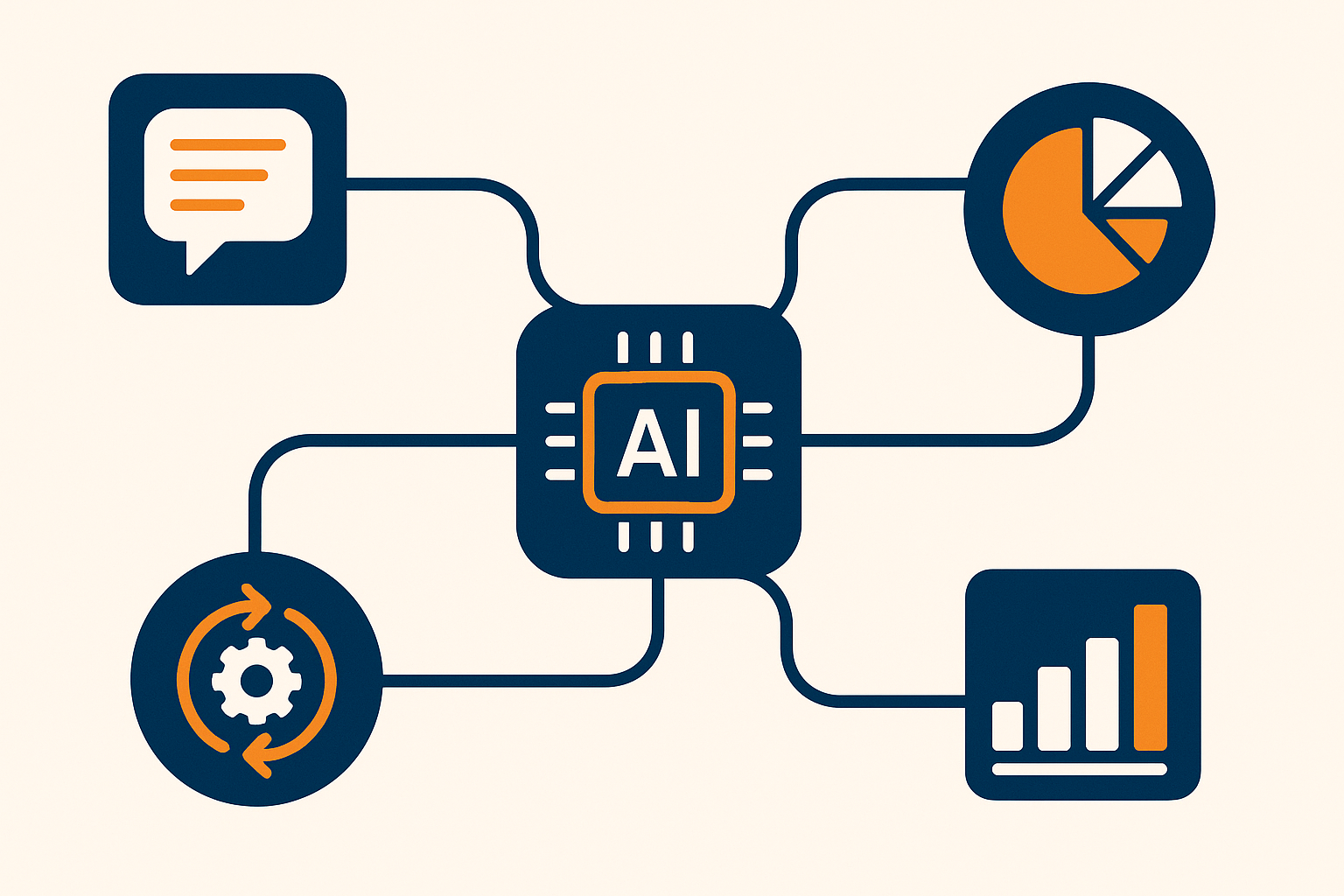
Integrating AI with Existing Tech Stacks
To get the most out of your digital infrastructure, utilizing flexible workflow optimization tools is highly recommended.
Integrating these solutions with your CRM and ERP software guarantees smooth data pipelines across different divisions.
If you are looking to revitalize your customer acquisition systems, discover our digital marketing services to combine automation with strategic outreach.
Challenges and Ethical Considerations
While adopting AI software trends keeps you ahead of competitors, companies must address data privacy and compliance. Refer to the official guidelines from Gartner reports regarding ethical AI deployment.
Ensure your models are thoroughly audited to mitigate bias and prevent sensitive customer data leaks.
Future-Proofing Your Business with Automation Strategies
Developing a long-term strategy requires combining human ingenuity with robust machine execution.
Scalable growth is achieved by continuously evaluating performance metrics and refining model permissions. Learn more about structural integrations from Zapier development documentation.
Ready to elevate your operations? Contact the experts at Qreo Digital today to build a tailored plan utilizing advanced workflows that transform your daily operations and secure your market position.
Frequently Asked Questions
What are AI automation tools?
These are software systems powered by machine learning algorithms that automate complex, multi-step digital workflows without human intervention.
How do AI automation tools benefit small businesses?
They allow small teams to scale operations, handle massive quantities of data, and manage client communications efficiently.
What is the difference between RPA and AI automation?
Traditional RPA follows static rules, while AI-powered automation adapts to dynamic contexts and handles unstructured information.
Can generative AI for enterprise improve customer support?
Yes, it empowers conversational agents with accurate, context-aware information to solve client inquiries instantly.
How do workflow optimization tools integrate with legacy software?
They utilize modern APIs, custom connectors, or intelligent screen scraping (cognitive RPA) to bridge legacy and cloud systems.
Are AI software trends safe for handling sensitive client data?
They are highly secure when implemented with private cloud models and strict data processing compliance protocols.
How does business process automation reduce operational costs?
It minimizes human data entry errors, drastically cuts down task processing time, and frees up employees for high-value work.
What is the best AI automation tool for marketing?
Platforms like HubSpot Breeze and Clay offer powerful features designed specifically to scale outbound sales and inbound workflows.
Do I need coding skills to use modern automation platforms?
Most modern tools utilize low-code or no-code visual interfaces, making them highly accessible for non-technical users.
How can Qreo Digital help implement these automated tools?
Qreo Digital provides custom design, API integration, and ongoing optimization support to ensure your automation strategy succeeds.
